
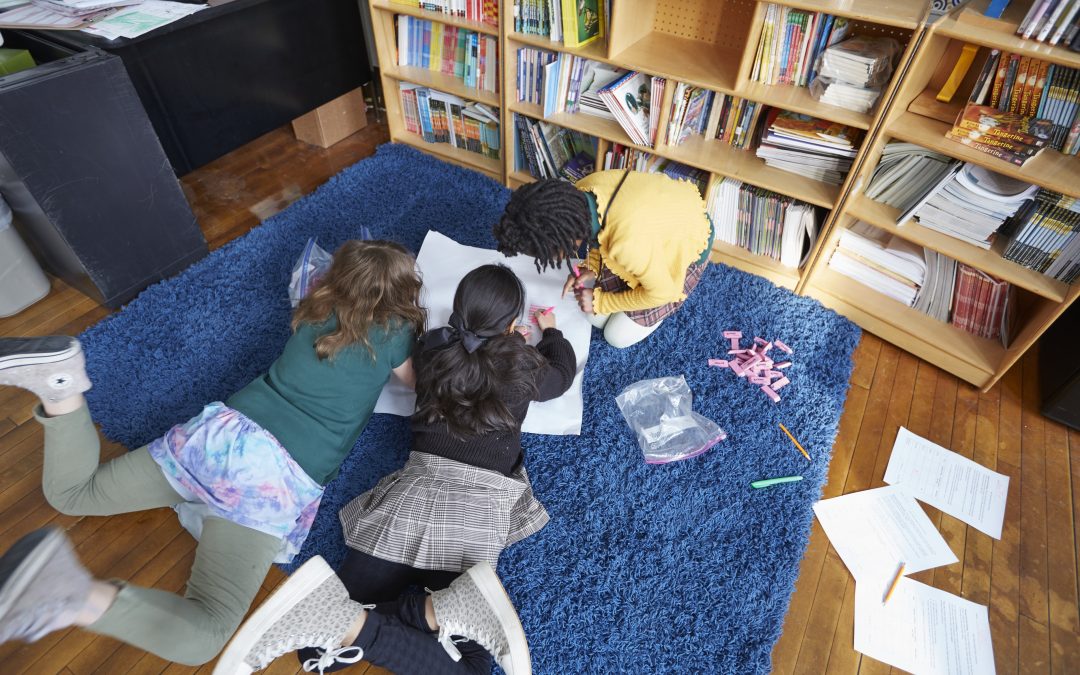
On the 2025-2026 Ohio School Report Card, every Near West fourth grader scored proficient or above on the state math test. Behind that result are two teachers with different styles and one shared belief: Students do their best in math when they feel confident as math learners.
Kori Morris, in her 10th year at Near West Intergenerational School, has taught fourth-grade math for about six. She wants students to discover that math unlocks things they already love to do. A future career is a long way off for most nine-year-olds, so Morris gives math a payoff students can feel right now: tabletop role-playing games she adapts for her class. Once students have a handle on a concept, practice turns into play, like a dungeon game board where they solve multiplication problems and roll a die to move their figurine. Later in the year, students build Dungeons & Dragons-style characters, form teams and set out on adventures with a hapless wizard who keeps getting into trouble only word problems can fix.
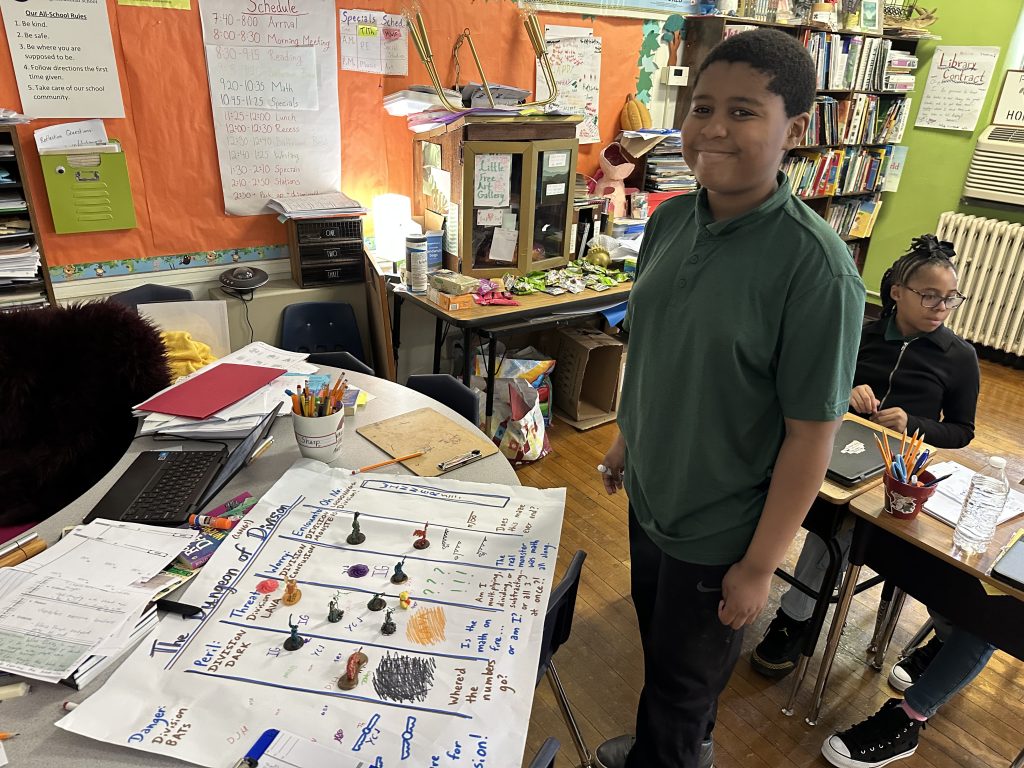
One of Ms. Morris’ students takes a turn with The Dungeon of Division, adapted from tabletop role-playing games to make math practice fun.
Matthew Phelps joined Near West last year after more than two decades as a college professor. He limits whole-class instruction to about 10 minutes, so students spend most of each period practicing at their own challenge level while he offers hints and questions instead of answers. New units start with play, like a recent “Decimal Olympics” where students measured long jumps to the nearest thousandth of a meter and awarded medals.
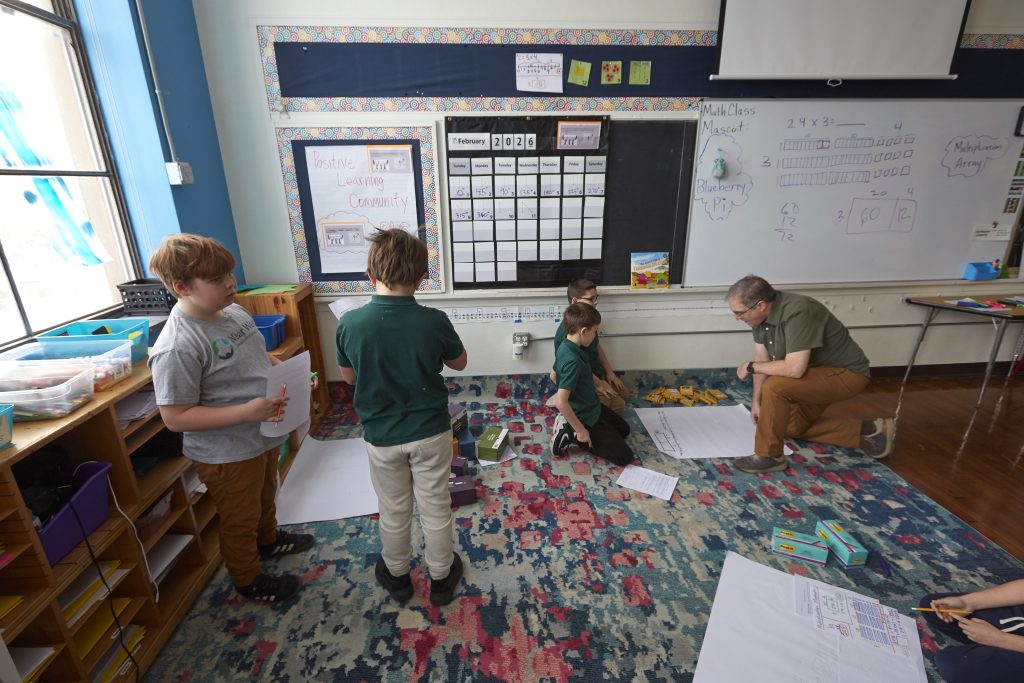
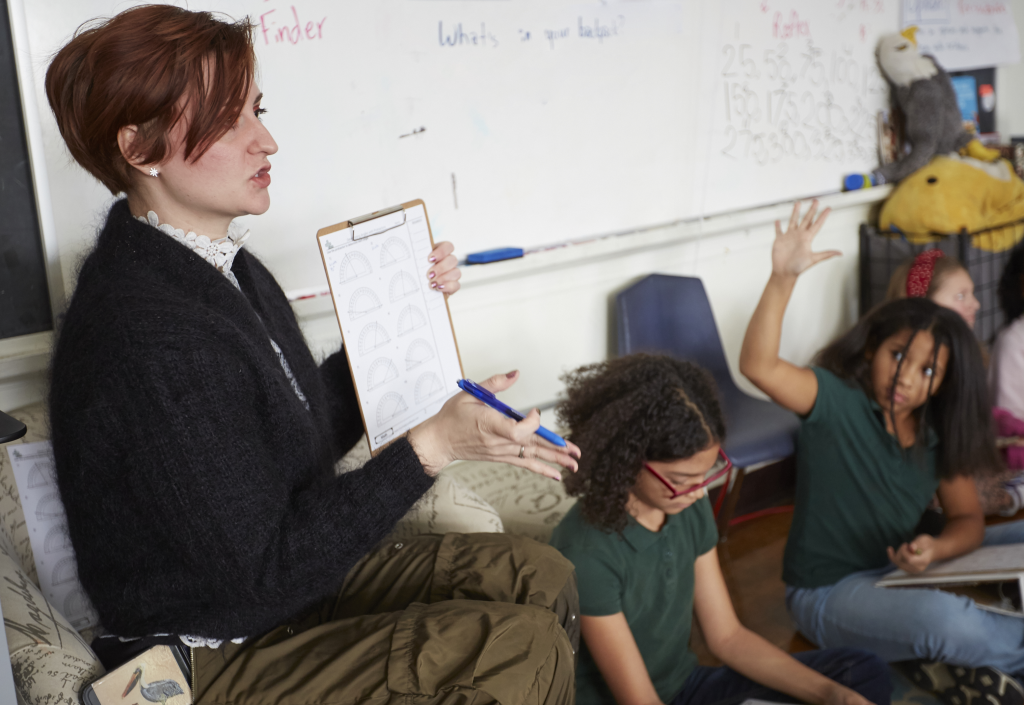
In Mr. Phelps’ math class, after 10 minutes of group instructions, students spend most of their time practicing and applying math to various activities at their own challenge level.
Phelps also looks for problems that are naturally mathematical, like budgeting, doubling a recipe or measuring a room for new carpet, and he tailors them to his students. When one student loved hockey, Phelps built a lesson on measuring angles for air hockey bank shots. He’s a big fan of math-art connections, too. Last year, students explored the golden ratio and golden spiral by measuring, cutting and assembling rectangles into a multi-colored golden rectangle, then worked out how to cut 45-degree angles to build cardboard picture frames. “My ideal classroom is both challenging and fun,” he said, “and, as much as possible, both things at the very same time.”
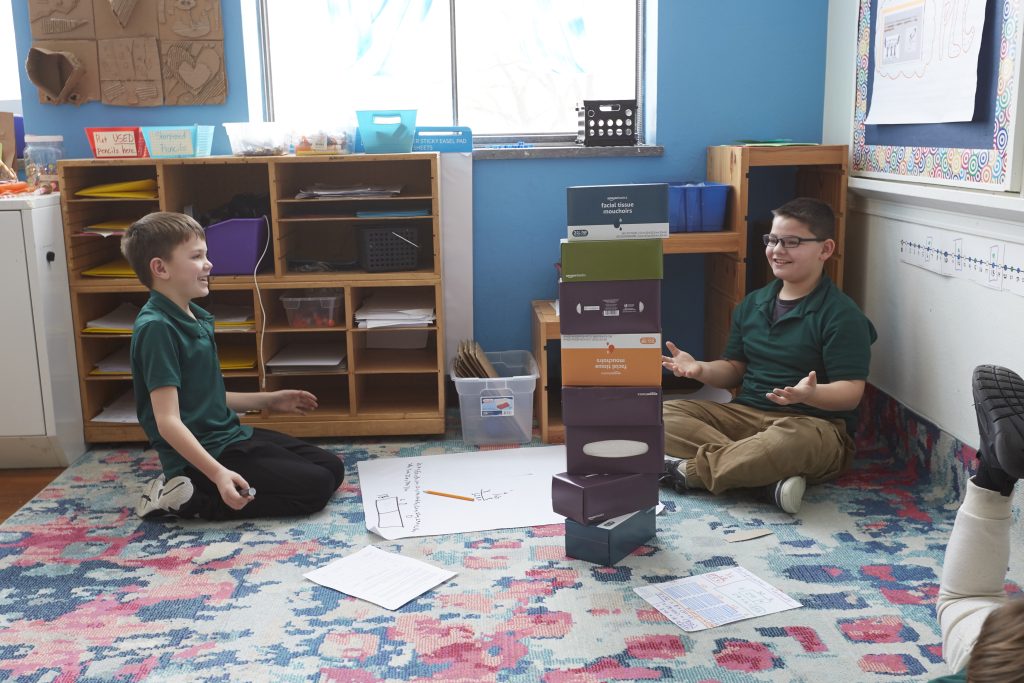
“My ideal classroom is both challenging and fun, and, as much as possible, both things at the very same time.” – Mr. Phelps
“Anyone can be a math person. It’s easy. Step 1, be a person. Step 2, do some math.”
–Matthew Phelps, Developing Stage teacher at Near West Intergenerational School
Both teachers treat mistakes as part of learning. “I often tell students that the only reason I’m interested in their answers is to find out whether or not their process works,” Phelps said.
“Even when it’s hard, the kids take that on, and they come out the other end so much stronger for it. Then they talk about how much they love math. That’s an amazing thing to see.” — Ms. Morris
For Morris, that mindset is what helps math land and stick long after test day.
“I never want education to be about the test,” Morris said. “Kids tend to do well on the test when they feel confident in themselves as math students, so I want it to be about how math helps us. Math can be really hard, like a lot of things in life, and we learn to work with it and to fail as part of the process. Even when it’s hard, the kids take that on, and they come out the other end so much stronger for it. Then they talk about how much they love math. That’s an amazing thing to see.”
“Even when it’s hard, the kids take that on, and they come out the other end so much stronger for it. Then they talk about how much they love math. That’s an amazing thing to see.”
– Kori Morris, Developing Stage teacher at Near West Intergenerational School
Students notice. On an end-of-year trip to the West Side Market, two of Phelps’ students insisted his class was the best, citing a geometry newsletter and a Pi Day party. A Morris student countered with a Dungeons & Dragons battle of giants. Morris settled it: “Really what you’re both saying is we both had pretty great math classes.”
Different approaches, one commitment to meeting every learner where they are. That’s how the Intergenerational Schools’ small, multi-age classes help each student build real understanding, and the confidence and pride that come with it.