
News & Stories from the Intergenerational Schools
Stay connected with the latest updates, student stories, and community celebrations from across our schools. From classroom moments to major milestones, discover what makes the Intergenerational Schools a place where students, families, and community grow together.
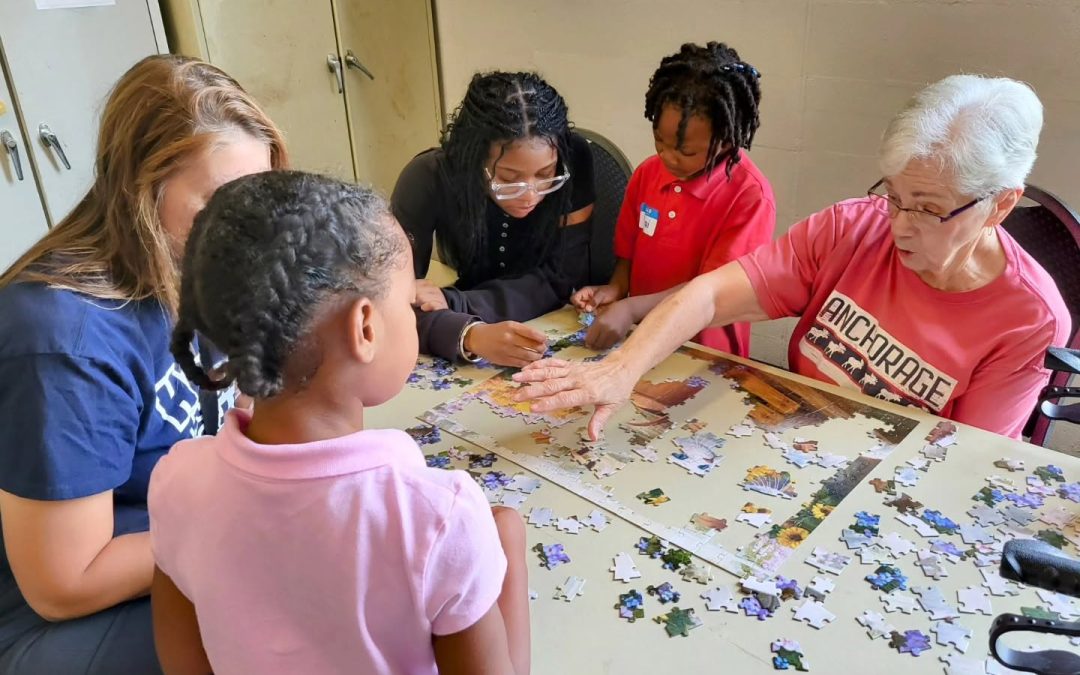
Extraordinary Perspectives: A Closer Look at Our Intergenerational Programming
 The Intergenerational Schools have once again been named a Program of Distinction by Generations United, the national organization behind the country’s leading certification for intergenerational programs. It’s the same recognition we first announced last year, awarded to programs that meet high standards for innovation, leadership, and impact in bringing younger and older generations together.
It’s the perfect opportunity to explain what intergenerational programming looks like at our schools, so we spoke with Seamus O’Hara, Director of Intergenerational Programming.
Defining Intergenerational Programming at Our Schools
“My job is to connect people, institutions, and opportunities in ways that benefit our students, our educators, and the broader community,” Seamus explained. “A significant part of that is building and maintaining relationships with our community partners, coordinating intergenerational visits across our campuses, and working with teachers to make sure those experiences complement what’s happening in their classrooms.”
Intergenerational visits comprise monthly class trips to senior centers, residential care facilities and other programs for older adults. The schools partner with 12 community host locations. Serving 21 classes with about 16 visits each month, this translates to roughly 160 visits over the year across both schools.
Seamus also oversees the Learning Partners program, which brings older adults, college students, and other community volunteers directly into the schools to support student learning. This year, about 50 Learning Partners are helping to help build literacy and math skills and intergenerational connections in the classroom.
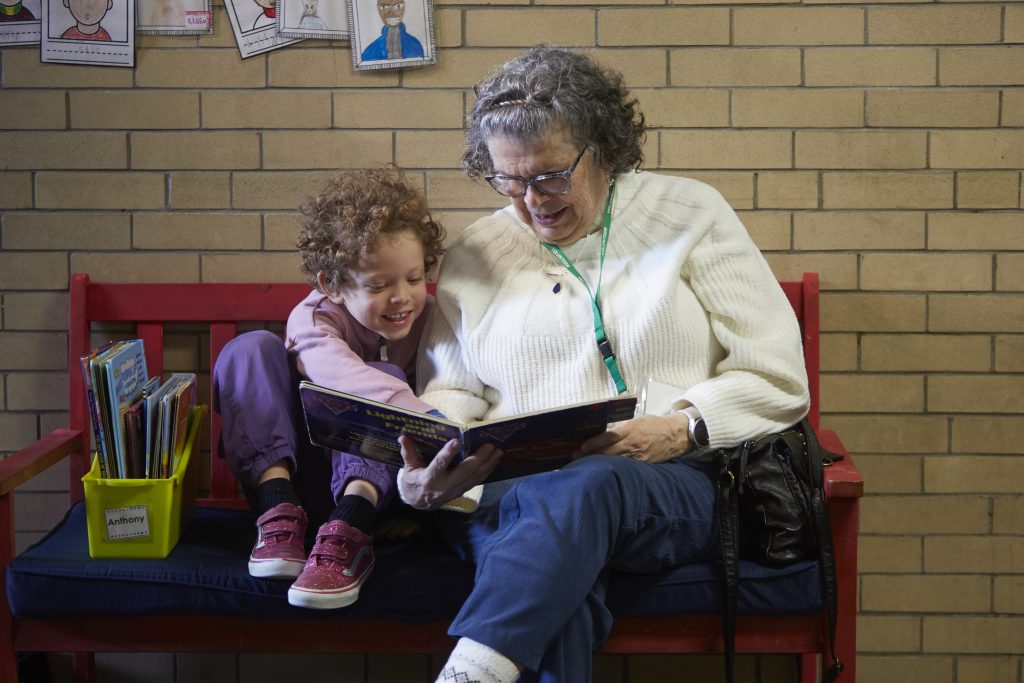
A Learning Partner and a Primary Stage (K-2) student practice reading together at Near West. Learning Partners visit weekly to provide one-on-one literacy and math practice to complement classroom activities and build intergenerational connections.
Building Relationships
Seamus explained that the fundamental goal of intergenerational visits is to facilitate meaningful relationships across generations. Multiple research studies have found that this kind of intergenerational contact improves well-being for older adults while helping students build empathy, communication skills, and a stronger sense of connection to their community.
Each class returns to the same host community every month, all year long, so students and older adults can build real relationships over time. That consistency is also what moves the program beyond the familiar model of children visiting older adults to entertain them or perform a service. “We’re interested in reciprocity,” he said. “Both generations should walk away having contributed something and having gained something.”
For host communities, one of the clearest signs of impact is anticipation. Residents recognize returning students, ask about them, and look forward to the next visit. “Our older adult partners have an enormous amount to contribute, and these visits create a space where that contribution is recognized and valued.”
Inside a Visit
In recent years, teachers have taken a more active role in guiding intergenerational visits, planning activities and preparing students so that each month’s trip connects with and complements academic and social goals in the classroom. Activities vary by learning stage and connect to Ohio’s learning standards while staying accessible and enjoyable for everyone. Students in the Applying stage (typically 7th and 8th graders in traditional school models) often serve as helpers and ambassadors, welcoming residents, supporting younger students, and making sure everyone feels included. “They’re practicing leadership in a very authentic environment,” Seamus said, building confidence, empathy, and communication skills that are hard to replicate through a classroom assignment.
A typical intergenerational visit includes about an hour of students and older adults partnering or forming small groups to play games, make art, read together, make music or just talk. While planned activities provide structure, often they set the stage for invaluable learning experiences you just can’t plan for.
“The learning happens when a student begins asking the person across the table about their childhood, their experiences, or what the world looked like when they were young,” Seamus said. These conversations can open a door to the past that no textbook can.
One of the program’s older adult friends is turning 101 this month. When he was the age of the students he visits, the country was in the middle of the Great Depression. “Our students can engage directly with someone whose life spans more than a century of history. That’s an extraordinary learning resource,” Seamus said.
Another resident, about 80 years old, recently shared that she was born in Alabama. Students realized she would have been about 9 during the Montgomery Bus Boycott, 17 during the Birmingham Campaign, and 19 during the Selma voting rights marches. For students, many of whom are Black, it was a powerful realization: Someone sitting across from them, sharing an ordinary activity, had lived through history they study in school.
“I don’t want to suggest that we know what her personal experiences were during those events without asking her,” Seamus said, “but that’s precisely what makes these relationships so valuable. They create opportunities for students to ask questions, develop historical perspective, and understand that history is not nearly as distant as it can sometimes seem.”
A Legacy to Build On
Intergenerational programming has been fundamental to our schools since their founding in 2000, and the latest recognition by Generations United is further evidence of the program’s value for students and the community. This year, Seamus is working on strengthening the connection between intergenerational visits and the Learning Partners program, creating more leadership opportunities for older students, and bringing back special events. Last year, that included “Wintergenerational” at the Cleveland Metroparks Chalet and Toboggan Chutes, a fun chance for generations to gather outside of school.
Become a Host Site
Senior living communities, senior centers, and other organizations interested in hosting monthly visits don’t need elaborate programming to take part, just the ability to host a consistent group of students each month. “What matters is having a welcoming environment and people who are excited to participate,” Seamus said. Becoming a host site starts with a conversation and often a visit from Seamus to learn about your community.
To start that conversation, contact Seamus O’Hara at sohara@igschools.org.
More Recent Posts

Composing Confidence through Music: Soundtrap at Near West
Innovative education happens wherever students have space to tap into new ways of thinking and understanding their world—whether that’s on stage with classmates, in reading discussions with older adults, or alone at a keyboard, composing an original piece of music....

Innovating Education: 25 Years of Doing School Differently
Innovation means building around what works, not just what's new. For 25 years, the Intergenerational Schools have designed every element of our model around two core truths: children learn at different paces and in different ways, and community strengthens learning...

From Auditions to Opening Night: TIS-East Brings Theater to Life
This March, the Intergenerational School-East put on its first-ever full musical production — and took it all the way to the Playhouse Square stage. The production of Winnie the Pooh Kids was made possible through Disney Musicals in Schools, a program hosted by...

Intergenerational Schools Recognized as Program of Distinction
The Intergenerational Schools have been named a Program of Distinction by Generations United, a national organization that recognizes outstanding intergenerational programs connecting younger and older people across the United States. The Program of Distinction...
Subscribe for Updates
Get the latest news, stories, and event invitations from the Intergenerational Schools delivered to your inbox.
Annual Reports
Explore highlights from each school year and learn more about the impact of our school model throughout our history.
Follow Our Story
Connect with the Intergenerational Schools on social media to see daily moments for our classrooms and community, get reminders & updates for families, and learn more about what makes our school model so special.